 |
Hermann Hesse at Top Ten Books |
 amazon.com
 amazon.uk
 amazon.ca
 amazon.fr
 amazon.de
 amazon.jp
|
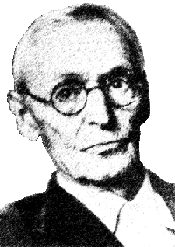 Hermann
Hesse
Hermann
Hesse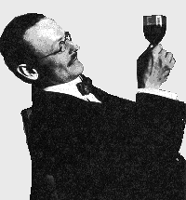 During
World War One, Hesse joined the pacifist Romain Rolland in
antiwar activities. He wrote antiwar tracts and novels. Hesse
also edited two newspapers for german prisoners of war being
a member of the Prisoners of War Welfare Organization. Hesse's
wartime activities alienated many of his friends and readers
who were enthralled with the militarism sweeping over Europe.
Hesse was advised in 1917 to stop his journalism on contemporary
issues, but he continued under the nom de plume Emil Sinclair.
At this time, Hesse's first marriage broke up. He left Germany
moving to Montagnola, Switzerland and became a Swiss citizen
in 1923. The war and a series of personal tragedies led him
to focus his writing on the spiritual search for new goals
and values.
During
World War One, Hesse joined the pacifist Romain Rolland in
antiwar activities. He wrote antiwar tracts and novels. Hesse
also edited two newspapers for german prisoners of war being
a member of the Prisoners of War Welfare Organization. Hesse's
wartime activities alienated many of his friends and readers
who were enthralled with the militarism sweeping over Europe.
Hesse was advised in 1917 to stop his journalism on contemporary
issues, but he continued under the nom de plume Emil Sinclair.
At this time, Hesse's first marriage broke up. He left Germany
moving to Montagnola, Switzerland and became a Swiss citizen
in 1923. The war and a series of personal tragedies led him
to focus his writing on the spiritual search for new goals
and values. Siddhartha: A Novel -Hermann Hesse - - Great product! The classic novel of a quest for knowledge that has delighted, inspired, and influenced generations of readers, writers, and thinkers—a perennial favorite for graduation gifts. Siddhartha: A Novel -Hermann Hesse - - Great product! The classic novel of a quest for knowledge that has delighted, inspired, and influenced generations of readers, writers, and thinkers—a perennial favorite for graduation gifts.Nominated as one of America’s best-loved novels by PBS’s The Great American Read Though set in a place and time far removed from the Germany of 1922, the year of the book’s debut, the novel is infused with the sensibilities of Hermann Hesse’s time, synthesizing disparate philosophies–Eastern religions, Jungian archetypes, Western individualism–into a unique vision of life as expressed through one man’s search for meaning. It is the story of the quest of Siddhartha, a wealthy Indian Brahmin who casts off a life of privilege and comfort to seek spiritual fulfillment and wisdom. On his journey, Siddhartha encounters wandering ascetics, Buddhist monks, and successful merchants, as well as a courtesan named Kamala and a simple ferryman who has attained enlightenment. Traveling among these people and experiencing life’s vital passages–love, work, friendship, and fatherhood–Siddhartha discovers that true knowledge is guided from within. List Price:$6.95 |
 The Glass Bead Game: (Magister Ludi) A Novel -Hermann Hesse - - Picador USA The Glass Bead Game is an ultra-aesthetic game which is played by the scholars, creamed off in childhood and nurtured in elite schools, in the province of Castalia. The Master of the Glass Bead Game, Joseph Knecht, holds the most exalted office in Castalia. He personifies the detachment, serenity and aesthetic vision which reward a life dedicated to perfection of the intellect. But can, indeed should, man live isolated from hunger, family, children, women, in a perfect world where passions are tamed by meditation, where academic discipline and order are paramount? This is Herman Hesse’s great novel. It is a major contribution to contemporary philosophic literature and has a powerful vision of universality, the inner unity of man’s cultural ideals and his search for personal perfection and social responsibility. The Glass Bead Game: (Magister Ludi) A Novel -Hermann Hesse - - Picador USA The Glass Bead Game is an ultra-aesthetic game which is played by the scholars, creamed off in childhood and nurtured in elite schools, in the province of Castalia. The Master of the Glass Bead Game, Joseph Knecht, holds the most exalted office in Castalia. He personifies the detachment, serenity and aesthetic vision which reward a life dedicated to perfection of the intellect. But can, indeed should, man live isolated from hunger, family, children, women, in a perfect world where passions are tamed by meditation, where academic discipline and order are paramount? This is Herman Hesse’s great novel. It is a major contribution to contemporary philosophic literature and has a powerful vision of universality, the inner unity of man’s cultural ideals and his search for personal perfection and social responsibility.List Price:$21.00 |
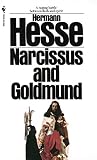 Narcissus and Goldmund -Hermann Hesse - - Bantam Hesse's novel of two medieval men, one quietly content with his religion and monastic life, the other in fervent search of more worldly salvation. This conflict between flesh and spirit, between emotional and contemplative man, was a life study for Hesse. It is a theme that transcends all time. Narcissus and Goldmund -Hermann Hesse - - Bantam Hesse's novel of two medieval men, one quietly content with his religion and monastic life, the other in fervent search of more worldly salvation. This conflict between flesh and spirit, between emotional and contemplative man, was a life study for Hesse. It is a theme that transcends all time. The Hesse Phenomenon “has turned into a vogue, the vogue into a torrent . . . He has appealed both to . . . an underground and to an establishment . . . and to the disenchanted young sharing his contempt for our industrial civilization.”—The New York Times Book Review List Price:$7.99 |
 Wandering: Notes and Sketches (English and German Edition) -Hermann Hesse - Prose, poetry, and drawings capture the author's spirit as he embarks on a new way of life close to nature Wandering: Notes and Sketches (English and German Edition) -Hermann Hesse - Prose, poetry, and drawings capture the author's spirit as he embarks on a new way of life close to natureList Price:$5.95 |
 The Fairy Tales of Hermann Hesse -Hermann Hesse - - Bantam Translated and with an introduction by Jack Zipes The Fairy Tales of Hermann Hesse -Hermann Hesse - - Bantam Translated and with an introduction by Jack ZipesA collection of twenty-two fairy tales by the Nobel Prize-winning novelist, most translated into English for the first time, show the influence of German Romanticism, psychoanalysis, and Eastern religion on his development as an author. Praise for The Fairy Tales of Hermann Hesse “Sometimes lush and lyrical, sometimes in the simple language of the parable, these tales elaborate Hesse's concerns with mortality, the unity of life and the isolation of the artist. . . . Quirky and evocative, Hesse's fairy tales stand alone, but also amplify the ideas and utopian longings of such counterculture avatars as Siddhartha and Steppenwolf.”—Publishers Weekly “Hesse unerringly creates the feel of a fairy tale. . . . Lay readers will enjoy this as much as literary specialists.”—Library Journal List Price:$18.00 |
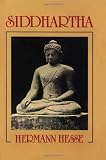 Siddhartha -Hermann Hesse - - ISBN13: 9780811202923 - Condition: New - Notes: BRAND NEW FROM PUBLISHER! 100% Satisfaction Guarantee. Tracking provided on most orders. Buy with Confidence! Millions of books sold! In the novel, Siddhartha, a young man, leaves his family for a contemplative life, then, restless, discards it for one of the flesh. He conceives a son, but bored and sickened by lust and greed, moves on again. Near dispair, Siddhartha comes to a river where he hears a unique sound. This sound signals the true beginning of life - the beginning of suffering, rejection, peace and, finally, wisdom. Siddhartha -Hermann Hesse - - ISBN13: 9780811202923 - Condition: New - Notes: BRAND NEW FROM PUBLISHER! 100% Satisfaction Guarantee. Tracking provided on most orders. Buy with Confidence! Millions of books sold! In the novel, Siddhartha, a young man, leaves his family for a contemplative life, then, restless, discards it for one of the flesh. He conceives a son, but bored and sickened by lust and greed, moves on again. Near dispair, Siddhartha comes to a river where he hears a unique sound. This sound signals the true beginning of life - the beginning of suffering, rejection, peace and, finally, wisdom.List Price:$26.95 |
 Demian: A Dual-Language Book (Dover Dual Language German) -Hermann Hesse - Demian: A Dual-Language Book (Dover Dual Language German) -Hermann Hesse - "All I really wanted was to try and live the life that was spontaneously welling up within me. Why was that so very difficult?" Generations of readers have recognized the impassioned cry that introduces the young narrator of Demian, and embraced this tale of a troubled young man's struggle toward self-awareness. Initially published in Berlin in 1919, the novel met with instant critical acclaim, as well as great popular success among people seeking answers amid the devastating aftermath of World War I. A brilliant psychological portrait of an individual's departure from social conventions in the search for spiritual fulfillment, Demian encompasses many of the themes associated with Hermann Hesse, its Noble Prize–winning author, particularly the duality of human nature and the quest for inner peace. Considered an important work in the evolution of twentieth-century European literature, this perceptive coming-of-age novel enjoys a particular resonance with young adults, a fact that has made Demian a perennial favorite in schools and colleges all over the world. This inexpensive edition, featuring an excellent new English translation, is sure to be welcomed by teachers and students, and by the legions of confirmed Hesse fans. List Price:$14.95 |
List Price: |
 Knulp: Three Tales from the Life of Knulp -Hermann Hesse - The German writer's classic work on the wanderings of an amiable vagabond Knulp: Three Tales from the Life of Knulp -Hermann Hesse - The German writer's classic work on the wanderings of an amiable vagabondList Price:$4.95 |
 Klingsor's Last Summer -Hermann Hesse - Literary Studies, German Literature, Philosophy, German Studies Klingsor's Last Summer -Hermann Hesse - Literary Studies, German Literature, Philosophy, German StudiesList Price: |
Magister Ludi - The Glass Bead Game
| The Glass Bead Game: (Magister Ludi) A Novel -Hermann Hesse - - Picador USA The Glass Bead Game is an ultra-aesthetic game which is played by the scholars, creamed off in childhood and nurtured in elite schools, in the province of Castalia. The Master of the Glass Bead Game, Joseph Knecht, holds the most exalted office in Castalia. He personifies the detachment, serenity and aesthetic vision which reward a life dedicated to perfection of the intellect. But can, indeed should, man live isolated from hunger, family, children, women, in a perfect world where passions are tamed by meditation, where academic discipline and order are paramount? This is Herman Hesse’s great novel. It is a major contribution to contemporary philosophic literature and has a powerful vision of universality, the inner unity of man’s cultural ideals and his search for personal perfection and social responsibility. List Price:$21.00 |
 Magister Ludi: The Glass Bead Game -HESSE HERMAN - The classical allegory of modern civilization Magister Ludi: The Glass Bead Game -HESSE HERMAN - The classical allegory of modern civilizationList Price: |
 The Glass Bead Game -Hermann Hesse - Set in the 23rd century,
The Glass Bead Game is the story of Joseph Knecht, who has been raised in Castalia, which has provided for the intellectual elite to grow and flourish. The Glass Bead Game -Hermann Hesse - Set in the 23rd century,
The Glass Bead Game is the story of Joseph Knecht, who has been raised in Castalia, which has provided for the intellectual elite to grow and flourish.
Since childhood, Knecht has been consumed with mastering the Glass Bead Game, which requires a synthesis of aesthetics and scientific arts, such as mathematics, music, logic, and philosophy, which he achieves in adulthood, becoming a Magister Ludi (Master of the Game). List Price:$20.97 |
 Magister Ludi (The Glass Bead Game) -Hermann Hesse - Magister Ludi (The Glass Bead Game) -Hermann Hesse - List Price: |
 Hermann Hesse's Magister Ludi (Previously published as the Glass Bead Game) -Hermann Hesse - This is Hesse's last and greatest work, which won for him the Nobel Prize for Literature. Described as "sublime" by Thomas Mann, admired by Andre Gide and T. S. Eliot, it is considred one of the important novels of this century. Hermann Hesse's Magister Ludi (Previously published as the Glass Bead Game) -Hermann Hesse - This is Hesse's last and greatest work, which won for him the Nobel Prize for Literature. Described as "sublime" by Thomas Mann, admired by Andre Gide and T. S. Eliot, it is considred one of the important novels of this century.List Price: |
 Little Manual for Players of the Glass Bead Game: The Way of Visual Contemplation -George Pennington - - Used Book in Good Condition Book by Pennington, George Little Manual for Players of the Glass Bead Game: The Way of Visual Contemplation -George Pennington - - Used Book in Good Condition Book by Pennington, GeorgeList Price:$11.95 |
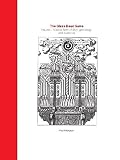 The Glass Bead Game: A Basic Form of Play, Genealogy, and Examples Pt. 1 -Paul Pilkington - In 1943, Hermann Hesse published his novel Das Glasperlenspiel (The Glass Bead Game). The game itself is a central theme of the novel. He gave only a sketch of how it might be played in practice, but made it clear that it is a game of comparisons and analogies across different subject areas, in the tradition of Pythagoras, Lull, Kepler, Kircher and others who searched for the unifying principles of all knowledge. The history of the development of the game in the novel demonstrates a direct analogy with the history of mathematics in the seventeenth century, as shaped by mathematicians with a deep interest in music theory. Paul Pilkington has brought the Glass Bead Game to life in an ongoing series of books. His version of the Glass Bead Game can be played at many levels of complexity. Its moves can be deeply technical, or conversationally playful. A move in a game about music and astronomy might ask: If the solar year in astronomy is like the octave in music, what is the equivalent of a lunar month in music? A more playful game about music and fashion asks: If Alexander McQueen is the Jimi Hendrix of fashion, what is his Purple Haze? Another asks: Who is the Napoleon of football, and what was his Waterloo? A more intimate game enquires: Where is your Ithaca? This first volume presents a basic form of play, genealogy, and examples including a short game concerning music and mathematics, architecture and I Ching, and many other examples including a game move linking a couplet of Arabic poetry, a theme from the Art of Fugue by Bach, and an I Ching Hexagram. There are two other volumes currently available, and a forthcoming volume will collect notable examples of glass bead game moves from literature, the media, and other diverse sources, and will put into play a range of opening gambits intended to inspire further exploration and elaboration of the form by others, especially in more informal contexts. Paul is sharing the ongoing work at his Twitter account @JustKnecht. Playfully using the language of the game itself: in bringing the concept of the dreamer into reality, these volumes do for Glasperlenspiel what Gothic architecture did for the light-drenched Enneads of Plotinus, what the Bolshevik revolution did for Capital by Marx, and what the World Wide Web did for Neuromancer by Gibson. The Glass Bead Game: A Basic Form of Play, Genealogy, and Examples Pt. 1 -Paul Pilkington - In 1943, Hermann Hesse published his novel Das Glasperlenspiel (The Glass Bead Game). The game itself is a central theme of the novel. He gave only a sketch of how it might be played in practice, but made it clear that it is a game of comparisons and analogies across different subject areas, in the tradition of Pythagoras, Lull, Kepler, Kircher and others who searched for the unifying principles of all knowledge. The history of the development of the game in the novel demonstrates a direct analogy with the history of mathematics in the seventeenth century, as shaped by mathematicians with a deep interest in music theory. Paul Pilkington has brought the Glass Bead Game to life in an ongoing series of books. His version of the Glass Bead Game can be played at many levels of complexity. Its moves can be deeply technical, or conversationally playful. A move in a game about music and astronomy might ask: If the solar year in astronomy is like the octave in music, what is the equivalent of a lunar month in music? A more playful game about music and fashion asks: If Alexander McQueen is the Jimi Hendrix of fashion, what is his Purple Haze? Another asks: Who is the Napoleon of football, and what was his Waterloo? A more intimate game enquires: Where is your Ithaca? This first volume presents a basic form of play, genealogy, and examples including a short game concerning music and mathematics, architecture and I Ching, and many other examples including a game move linking a couplet of Arabic poetry, a theme from the Art of Fugue by Bach, and an I Ching Hexagram. There are two other volumes currently available, and a forthcoming volume will collect notable examples of glass bead game moves from literature, the media, and other diverse sources, and will put into play a range of opening gambits intended to inspire further exploration and elaboration of the form by others, especially in more informal contexts. Paul is sharing the ongoing work at his Twitter account @JustKnecht. Playfully using the language of the game itself: in bringing the concept of the dreamer into reality, these volumes do for Glasperlenspiel what Gothic architecture did for the light-drenched Enneads of Plotinus, what the Bolshevik revolution did for Capital by Marx, and what the World Wide Web did for Neuromancer by Gibson.List Price:$12.75 |
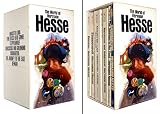 The World of Herman Hesse: Magister Ludi; Steppenwolf; Narcissus and Goldmund; Siddhartha; Demian [Boxed Set] -Hermann Hesse - The World of Herman Hesse: Magister Ludi; Steppenwolf; Narcissus and Goldmund; Siddhartha; Demian [Boxed Set] -Hermann Hesse - List Price: |
 Glass Bead Game Magister Ludi 1ST Edition Us - - Glass Bead Game Magister Ludi 1ST Edition Us Hardcover
by Hermann Hesse(Author) Glass Bead Game Magister Ludi 1ST Edition Us - - Glass Bead Game Magister Ludi 1ST Edition Us Hardcover
by Hermann Hesse(Author)List Price: |
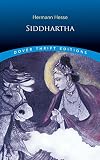 Siddhartha (Dover Thrift Editions) -Hermann Hesse - Siddhartha (Dover Thrift Editions) -Hermann Hesse - This classic novel of self-discovery has inspired generations of seekers. With parallels to the enlightenment of the Buddha, Hesse's Siddhartha is the story of a young Brahmin's quest for the ultimate reality. His quest takes him from the extremes of indulgent sensuality to the rigors of ascetism and self-denial. At last he learns that wisdom cannot be taught — it must come from one's own experience and inner struggle. Steeped in the tenets of both psychoanalysis and Eastern mysticism, Siddhartha presents a strikingly original view of man and culture, and the arduous process of self-discovery that leads to reconciliation, harmony, and peace. List Price:$4.00 |
Hermann Hesse on DVD
List Price: |
Journey to the East
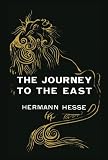 The Journey to the East -Hermann Hesse - - Used Book in Good Condition 2011 Reprint of 1957 English Translation. Full facsimile of the original edition, not reproduced with Optical Recognition Software. "Journey to the East" is written from the point of view of a man who becomes a member of "The League", a timeless religious sect whose members include famous fictional and real characters, such as Plato, Mozart, Pythagoras, Paul Klee, Don Quixote, Tristram Shandy, Baudelaire, and the ferryman Vasudeva, a character from one of Hesse's earlier works, Siddhartha. A branch of the group goes on a pilgrimage to "the East" in search of the "ultimate Truth". The conclusion of the short novel is a stroke of Hesse's typical Eastern mysticism at its finest. Hermann Hesse was born in Calw in the Black Forest on July 2, 1877, and from an early age was obsessed with the mystery of existence and humanity's place in the Universe. The Journey to the East is Hesse's tale of inner pilgrimage, an allegory on human desire for enlightenment and the long road that must be traveled to that ultimate goal. Using remarkably clear and accessible language, the book brings together the experience and conclusions of many years of spiritual struggle. The Journey to the East -Hermann Hesse - - Used Book in Good Condition 2011 Reprint of 1957 English Translation. Full facsimile of the original edition, not reproduced with Optical Recognition Software. "Journey to the East" is written from the point of view of a man who becomes a member of "The League", a timeless religious sect whose members include famous fictional and real characters, such as Plato, Mozart, Pythagoras, Paul Klee, Don Quixote, Tristram Shandy, Baudelaire, and the ferryman Vasudeva, a character from one of Hesse's earlier works, Siddhartha. A branch of the group goes on a pilgrimage to "the East" in search of the "ultimate Truth". The conclusion of the short novel is a stroke of Hesse's typical Eastern mysticism at its finest. Hermann Hesse was born in Calw in the Black Forest on July 2, 1877, and from an early age was obsessed with the mystery of existence and humanity's place in the Universe. The Journey to the East is Hesse's tale of inner pilgrimage, an allegory on human desire for enlightenment and the long road that must be traveled to that ultimate goal. Using remarkably clear and accessible language, the book brings together the experience and conclusions of many years of spiritual struggle.List Price:$7.50 |
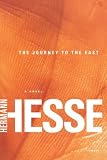 The Journey to the East by Hesse, Hermann (2003) Paperback - - Will be shipped from US. Used books may not include companion materials, may have some shelf wear, may contain highlighting/notes, may not include CDs or access codes. 100% money back guarantee. The Journey to the East by Hesse, Hermann (2003) Paperback - - Will be shipped from US. Used books may not include companion materials, may have some shelf wear, may contain highlighting/notes, may not include CDs or access codes. 100% money back guarantee.List Price: |
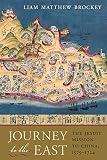 Journey to the East: The Jesuit Mission to China, 1579-1724 -Liam Matthew Brockey - - China Journey to the East: The Jesuit Mission to China, 1579-1724 -Liam Matthew Brockey - - China It was one of the great encounters of world history: highly educated European priests confronting Chinese culture for the first time in the modern era. This “journey to the East” is explored by Liam Brockey as he retraces the path of the Jesuit missionaries who sailed from Portugal to China, believing that, with little more than firm conviction and divine assistance, they could convert the Chinese to Christianity. Moving beyond the image of Jesuits as cultural emissaries, his book shows how these priests, in the first concerted European effort to engage with Chinese language and thought, translated Roman Catholicism into the Chinese cultural frame and eventually claimed two hundred thousand converts. The first narrative history of the Jesuits’ mission from 1579 until the proscription of Christianity in China in 1724, this study is also the first to use extensive documentation of the enterprise found in Lisbon and Rome. The peril of travel in the premodern world, the danger of entering a foreign land alone and unarmed, and the challenge of understanding a radically different culture result in episodes of high drama set against such backdrops as the imperial court of Peking, the villages of Shanxi Province, and the bustling cities of the Yangzi Delta region. Further scenes show how the Jesuits claimed conversions and molded their Christian communities into outposts of Baroque Catholicism in the vastness of China. In the retelling, this story reaches across continents and centuries to reveal the deep political, cultural, scientific, linguistic, and religious complexities of a true early engagement between East and West. List Price:$26.50 |
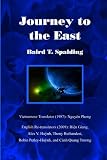 Journey to the East -ARRAY(0x1df4340) - Under no circumstances will we be capable of constructing a pyramid as the Egyptians did thousands of years ago. Not only did such a glorious civilization utterly vanish but its unequivocal disappearance also authenticated the universal law “Whatsoever a man sows that shall he also reap”. Regardless of how giant science has made its leap since that time, it completely fails to substantiate trustworthy facts. So, what are the possible explanations? Although the majority of Westerners have refused to recognize the Eastern philosophies—causality, reincarnation and karma—up to the 19th century, it has not escaped their notice that many true masters from the Far East are supporting and directing humans to their predestined destiny. By witnessing miraculous performances, perceiving amazing phenomena, and absorbing enthralled conversations bestowed upon by those Eastern masters, Spalding eloquently explained and effectively launched spiritual and intellectual knowledge to the Western world in his Journey to the East. Baird Spalding’s account of his journey to the Far East in 1894 offered the Western world a number of innovative resolutions that conceptually yet conventionally transcend spiritual and intellectual knowledge paradigm. Journey to the East -ARRAY(0x1df4340) - Under no circumstances will we be capable of constructing a pyramid as the Egyptians did thousands of years ago. Not only did such a glorious civilization utterly vanish but its unequivocal disappearance also authenticated the universal law “Whatsoever a man sows that shall he also reap”. Regardless of how giant science has made its leap since that time, it completely fails to substantiate trustworthy facts. So, what are the possible explanations? Although the majority of Westerners have refused to recognize the Eastern philosophies—causality, reincarnation and karma—up to the 19th century, it has not escaped their notice that many true masters from the Far East are supporting and directing humans to their predestined destiny. By witnessing miraculous performances, perceiving amazing phenomena, and absorbing enthralled conversations bestowed upon by those Eastern masters, Spalding eloquently explained and effectively launched spiritual and intellectual knowledge to the Western world in his Journey to the East. Baird Spalding’s account of his journey to the Far East in 1894 offered the Western world a number of innovative resolutions that conceptually yet conventionally transcend spiritual and intellectual knowledge paradigm.List Price:$5.70 |
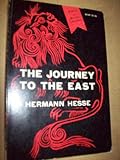 The Journey to the East -Hesse Hermann - mystical book -- Hesse at his best. The Journey to the East -Hesse Hermann - mystical book -- Hesse at his best.List Price: |
 Our journey to the land of flying balloons -Andrea and Ashley Dimitroff - Join Nick and Aunt Amy on their adventure to the land of flying balloons! Nick and Amy enjoy time together as they explore exotic places, try interesting food, and make lasting memories.Illustrated by Lori Vaughn Our journey to the land of flying balloons -Andrea and Ashley Dimitroff - Join Nick and Aunt Amy on their adventure to the land of flying balloons! Nick and Amy enjoy time together as they explore exotic places, try interesting food, and make lasting memories.Illustrated by Lori VaughnList Price:$10.00 |
 Journey to the East (The MIT Press) -Le Corbusier - Journey to the East (The MIT Press) -Le Corbusier - Available again after many years, the legendary travel diary kept by the young Le Corbusier on his journey through the Balkans in 1911. This is the legendary travel diary that the twenty-four-year-old Charles-Édouard Jeanneret (Le Corbusier) kept during his formative journey through Southern, Central, and Eastern Europe in 1911. In a flood of highly personal impressions and visual notations, it records his first contact with the vernacular architecture that would preoccupy him for the rest of his life and his first sight of the monuments he most admired: the mosque complexes, the Acropolis, and the Parthenon. Le Corbusier himself suppressed publication of this book during his lifetime; after his death, the text was released as “an unprefaced last confession.” Journey to the East can be read as a bildungsroman by a young author who would go on to become one of the greatest architects of the twentieth century. It is very much a story of awakening and a voyage of discoveries, recording a seven-month journey that took Le Corbusier from Berlin through Vienna, Budapest, Bucharest, Istanbul, Athos, Athens, Naples, and Rome, among other places. Le Corbusier considered this journey the most significant of his life; the compulsion he felt to record images and impressions established a practice he would continue for the rest of his career. For the next five decades, he would fill notebooks with ideas and sketches; he never stopped deriving inspiration from the memories of his first contact with the East, making this volume as much a historical document as a personal confession and diary. Ivan Žaknic's highly regarded translation was first published by The MIT Press in 1987 but has been unavailable for many years. List Price:$29.95 |
 Daughters of the Samurai: A Journey from East to West and Back -Janice P. Nimura - - W W Norton Co Inc Daughters of the Samurai: A Journey from East to West and Back -Janice P. Nimura - - W W Norton Co Inc "Nimura paints history in cinematic strokes and brings a forgotten story to vivid, unforgettable life." ―Arthur Golden, author of Memoirs of a Geisha In 1871, five young girls were sent by the Japanese government to the United States. Their mission: learn Western ways and return to help nurture a new generation of enlightened men to lead Japan. Raised in traditional samurai households during the turmoil of civil war, three of these unusual ambassadors―Sutematsu Yamakawa, Shige Nagai, and Ume Tsuda―grew up as typical American schoolgirls. Upon their arrival in San Francisco they became celebrities, their travels and traditional clothing exclaimed over by newspapers across the nation. As they learned English and Western customs, their American friends grew to love them for their high spirits and intellectual brilliance. The passionate relationships they formed reveal an intimate world of cross-cultural fascination and connection. Ten years later, they returned to Japan―a land grown foreign to them―determined to revolutionize women’s education. Based on in-depth archival research in Japan and in the United States, including decades of letters from between the three women and their American host families, Daughters of the Samurai is beautifully, cinematically written, a fascinating lens through which to view an extraordinary historical moment. Map; 8 pages of illustrationsList Price:$16.95 |
 Journey to the East -ARRAY(0x1582a20) - Under no circumstances will we be capable of constructing a pyramid as the Egyptians did thousands of years ago. Not only did such a glorious civilization utterly vanish but its unequivocal disappearance also authenticated the universal law “Whatsoever a man sows that shall he also reap”. Regardless of how giant science has made its leap since that time, it completely fails to substantiate or corroborate trustworthy facts. So, what are the possible explanations? Journey to the East -ARRAY(0x1582a20) - Under no circumstances will we be capable of constructing a pyramid as the Egyptians did thousands of years ago. Not only did such a glorious civilization utterly vanish but its unequivocal disappearance also authenticated the universal law “Whatsoever a man sows that shall he also reap”. Regardless of how giant science has made its leap since that time, it completely fails to substantiate or corroborate trustworthy facts. So, what are the possible explanations? Although the majority of Westerners have refused to recognize the Eastern philosophies—causality, reincarnation and karma—up to the 19th century, it has not escaped their notice that many true masters from the Far East are supporting and directing humans to their predestined destiny. By witnessing miraculous performances, perceiving amazing phenomena and absorbing enthralled conversations bestowed by those Eastern masters, Mr. Spalding eloquently explained and effectively launched spiritual as well as intellectual knowledge to the Western world in his Journey to the East. Baird Spalding’s account of his journey to the Far East in 1894 offered the Western world a number of innovative resolutions that conceptually yet conventionally transcend spiritual and intellectual knowledge paradigm. List Price: |
 Proof of Heaven: A Neurosurgeon's Journey into the Afterlife -Eben Alexander - - Paperback The #1 New York Times bestselling account of a neurosurgeon's own near-death experience—for readers of 7 Lessons from Heaven. Proof of Heaven: A Neurosurgeon's Journey into the Afterlife -Eben Alexander - - Paperback The #1 New York Times bestselling account of a neurosurgeon's own near-death experience—for readers of 7 Lessons from Heaven.Thousands of people have had near-death experiences, but scientists have argued that they are impossible. Dr. Eben Alexander was one of those scientists. A highly trained neurosurgeon, Alexander knew that NDEs feel real, but are simply fantasies produced by brains under extreme stress. Then, Dr. Alexander’s own brain was attacked by a rare illness. The part of the brain that controls thought and emotion—and in essence makes us human—shut down completely. For seven days he lay in a coma. Then, as his doctors considered stopping treatment, Alexander’s eyes popped open. He had come back. Alexander’s recovery is a medical miracle. But the real miracle of his story lies elsewhere. While his body lay in coma, Alexander journeyed beyond this world and encountered an angelic being who guided him into the deepest realms of super-physical existence. There he met, and spoke with, the Divine source of the universe itself. Alexander’s story is not a fantasy. Before he underwent his journey, he could not reconcile his knowledge of neuroscience with any belief in heaven, God, or the soul. Today Alexander is a doctor who believes that true health can be achieved only when we realize that God and the soul are real and that death is not the end of personal existence but only a transition. This story would be remarkable no matter who it happened to. That it happened to Dr. Alexander makes it revolutionary. No scientist or person of faith will be able to ignore it. Reading it will change your life. List Price:$17.00 |